FIRST
Oceanus
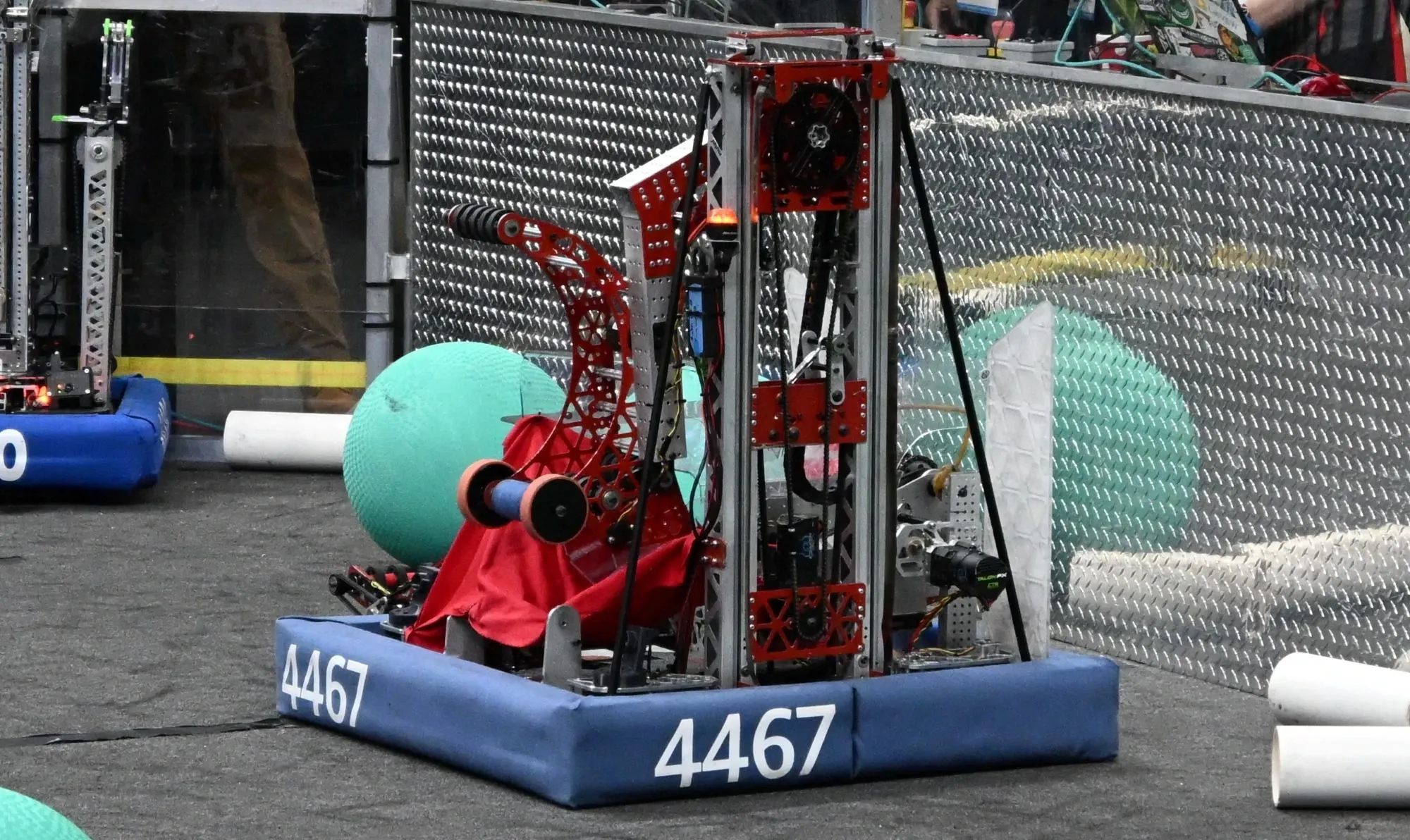
Oceanus is 4467's v2 robot for the 2025 FIRST Robotics Competition, Reefscape.
Summary
Oceanus was the last robot I worked on. I was heavily involved in a lot of different systems. I led the development of a lot of different prototypes using our new laser cutter. While I was still heavily involved in programming, I took a bigger role on the mechanical and electrical subteams, where I assembled systems such as our climber and intake while also laying out the electrical system and wiring the robot. Beyond the technical aspects, I took on a big strategic role as well as mentoring newer members.
Oceanus was a "Frankenstein" robot in the sense that we took heavy inspiration from the best systems on other robots and adapted them to our own design. The overall archetype was inspired by team 1540. End effector and ground intake was inspired by team 694. The climber was inspired by team 6328. Lastly, the elevator was inspired by team 7312. While these were the final systems, we prototyped with many different ideas until we found the ones that worked best for us.
Oceanus was a much longer build process than typical, but that was by design. We wanted to make sure that we had a very robust robot that could be competitive against the best in the world with the capability to compete under any startegic gameplan. Oceanus was continuously iterated on up until the World Championship, where we were ranked as high as 5th after our 6th match, eventually finishing with a 7-3 record. With this robot, we also won the Smoky Mountain Regional as the 4th ranked team with a record of 13-3. Once again, Oceanus was the best performing robot in the Western Pennsylvania region according to EPA.
Mechanical Notebook
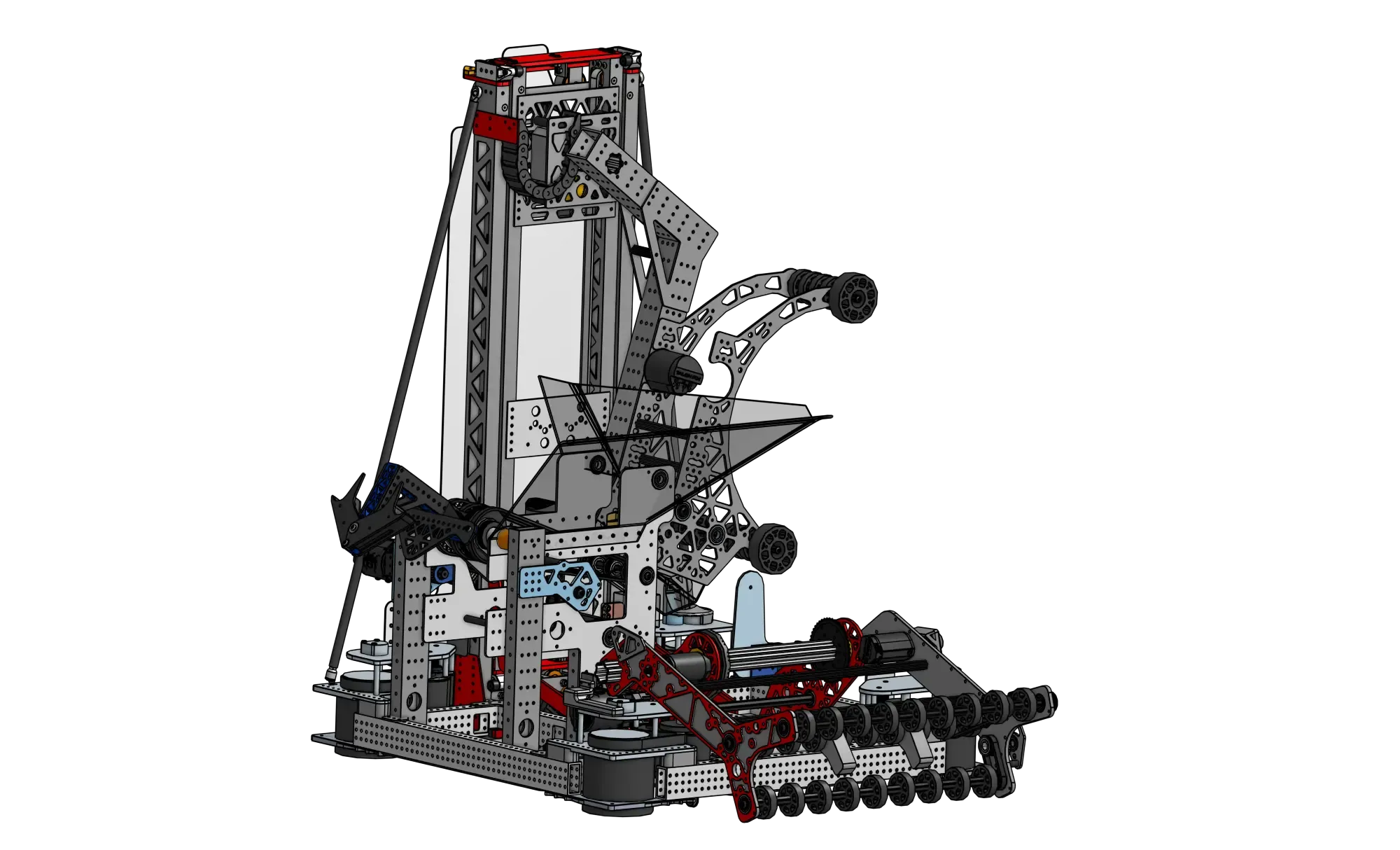
Once again, shoutout Ian. Check out his work here → Oceanus Onshape
Drivetrain
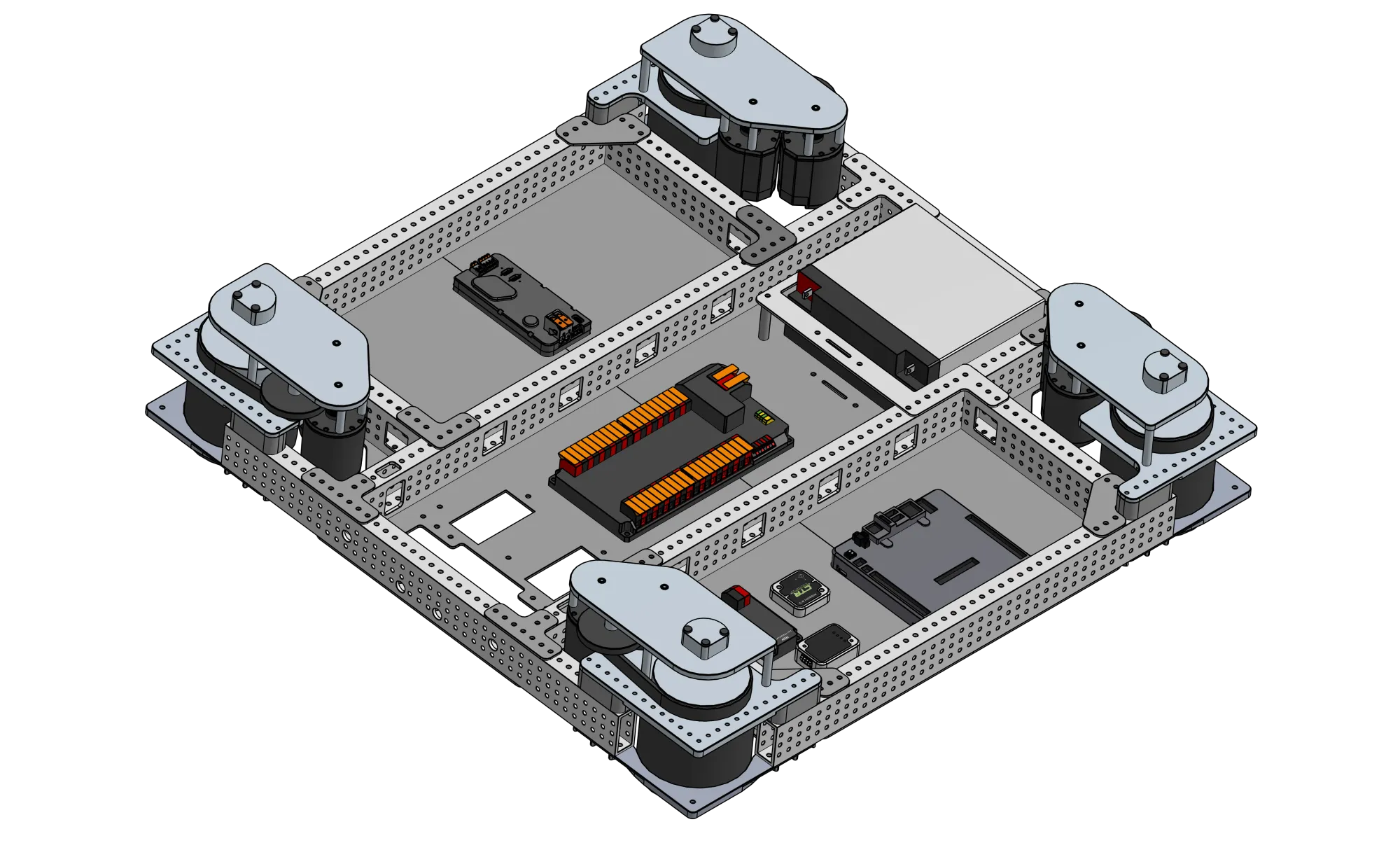
Oceanus's drivetrain used L2 gear ratio with MK4N modules. Once again, we continued to use the Kraken X60 drive motors and Falcon 500 azimuth motor configuration as that was the most resource efficient and effective drivetrain config we used in the past. We used the MK4N modules because they were thinner and worked best for our package. We also changed to an L2 ratio because we no longer needed to play full field defense and wanted to be able to accelerate faster on our side of the field for quicker cycles. For Oceanus, we went back to having two cameras on the robot both facing in the direction of the end effector. This helped immensely with our localization when we scored at different sections on the reef.
Elevator
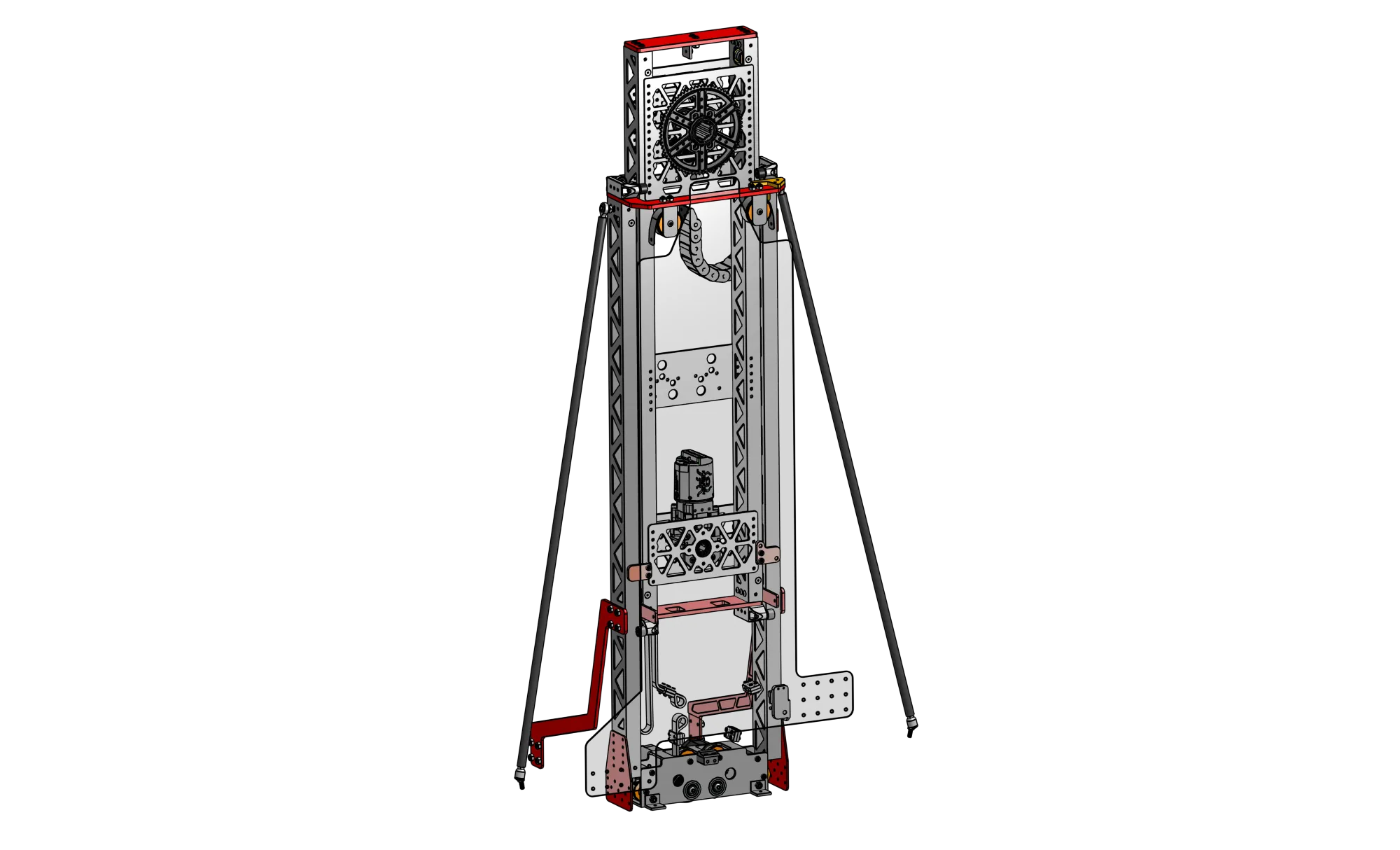
Oceanus's elevator was a one-stage elevator with a really tall carriage. The elevator itself was belt-driven, which allowed us to have a compact gearbox, in which we packaged two inline Kraken X60s at the bottom. We also implemented two constant force springs to give us extra pulling power to counteract the effect of gravity while extending. We also used long hex support rods to help with the stability of the elevator. One change we made was to use a single-stage elevator instead of a two-stage elevator. This was because we didn't need the extra height to accomplish all objectives, and we wanted to save weight.
Intake
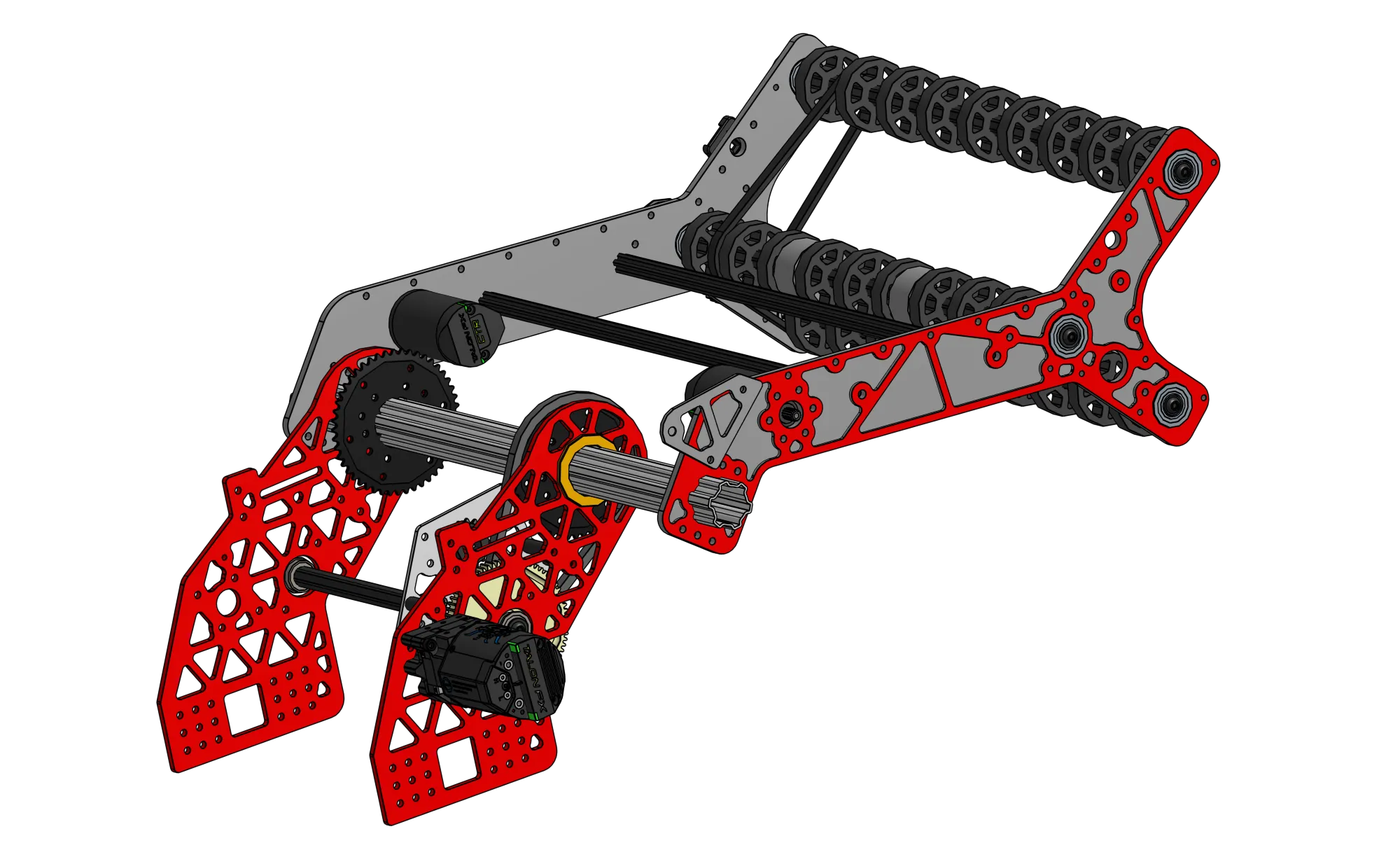
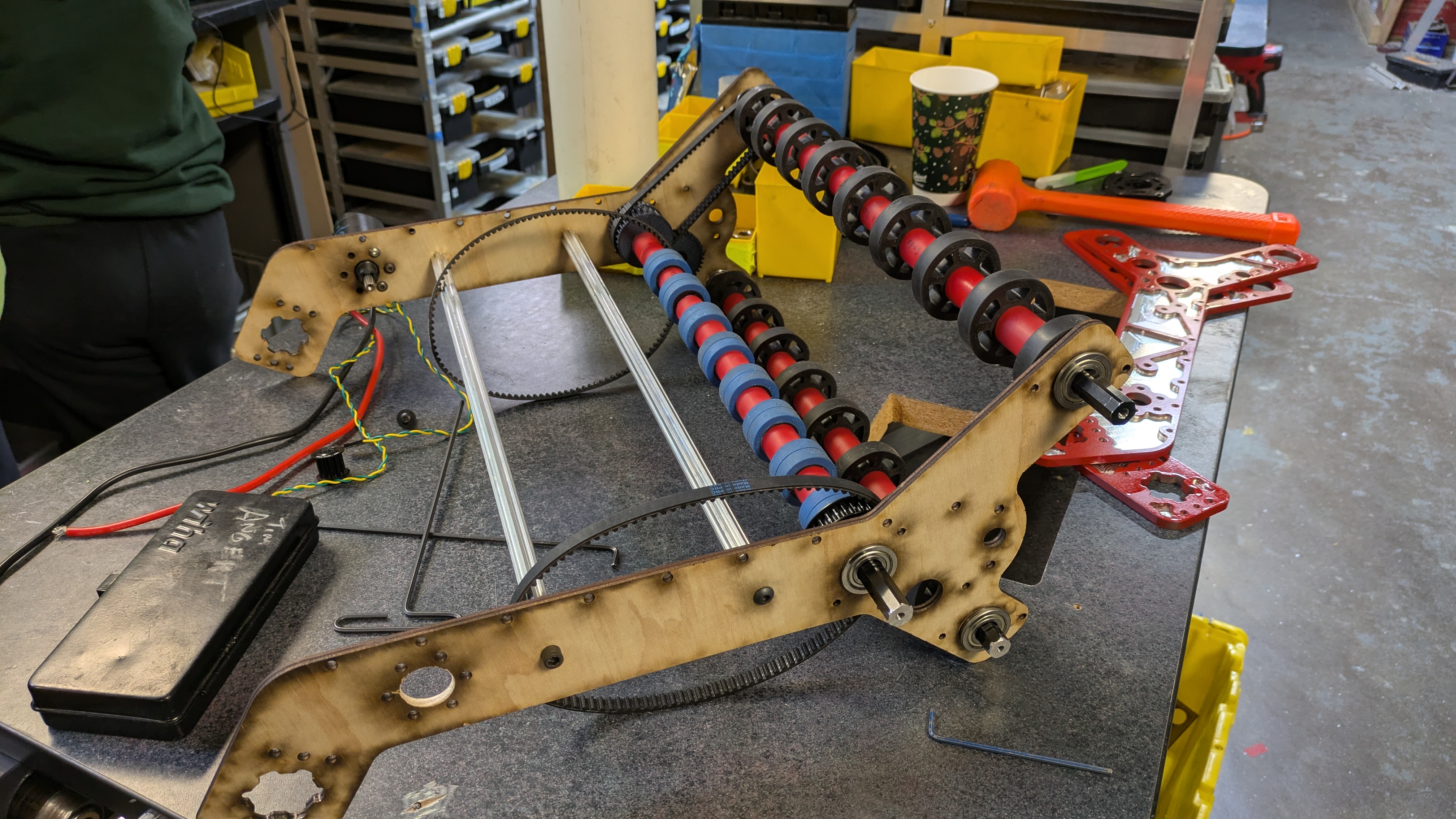
Oceanus's intake was an OTB pivoting intake with three sets of rollers. The entire intake pivoted about a MAXSpline shaft driven by a Kraken X60 with a 5:1 Max Planetary Gearbox. The two sets of rollers that made initial contact were 2" squish wheels. The roller that helped push the coral into our hopper system were 1" sushi wheels. We protoyped with wheels until we found the configuration that allowed for the best mix of compliance and power. The rollers were driven through two Kraken X44s on a belt-pulley system. This intake allowed us to intake coral from the ground, and later, we found we could even use it to intake algae from the ground.
Climber/Hopper
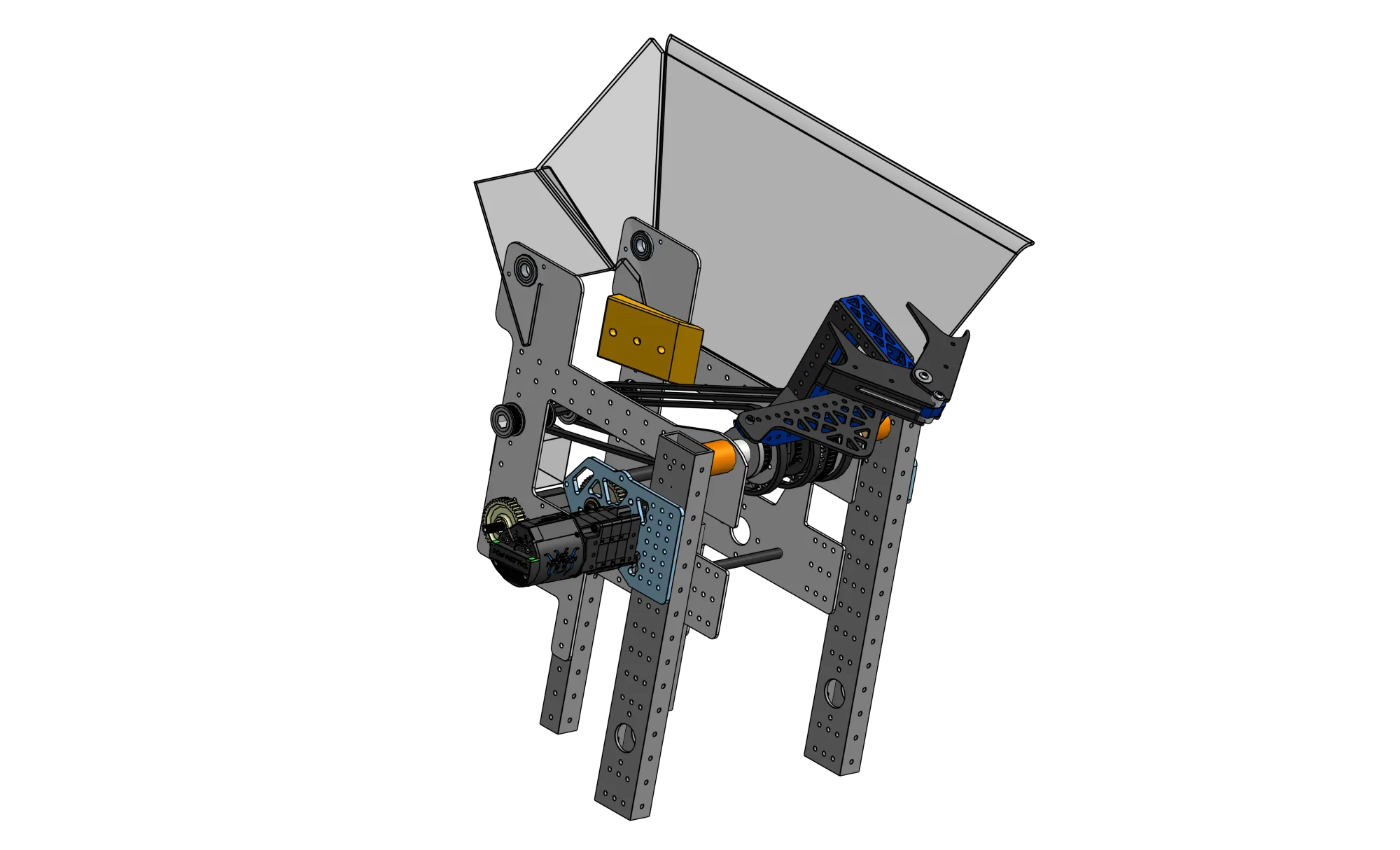
Oceanus's climber and hopper were two separate systems that were packaged together. The hopper system starts with the polycarbonate funnel. The funnel was a multi-hour process of using a heat bar to shape the right form for the coral to slide down into the hopper from both the ground intake and human player station. The climber arm was an exact replica of team 6328's climber arm. It used a steel hex shaft for the main drive shaft and had a Kraken X60 geared to 400:1. One thing we changed on the climber was that we custom milled aluminum input stage because the old ones kept breaking. We also attached two sets of sponsor panels to the bumpers on the climber side to help with both aesthetics and guiding the cage into our climber.
End Effector
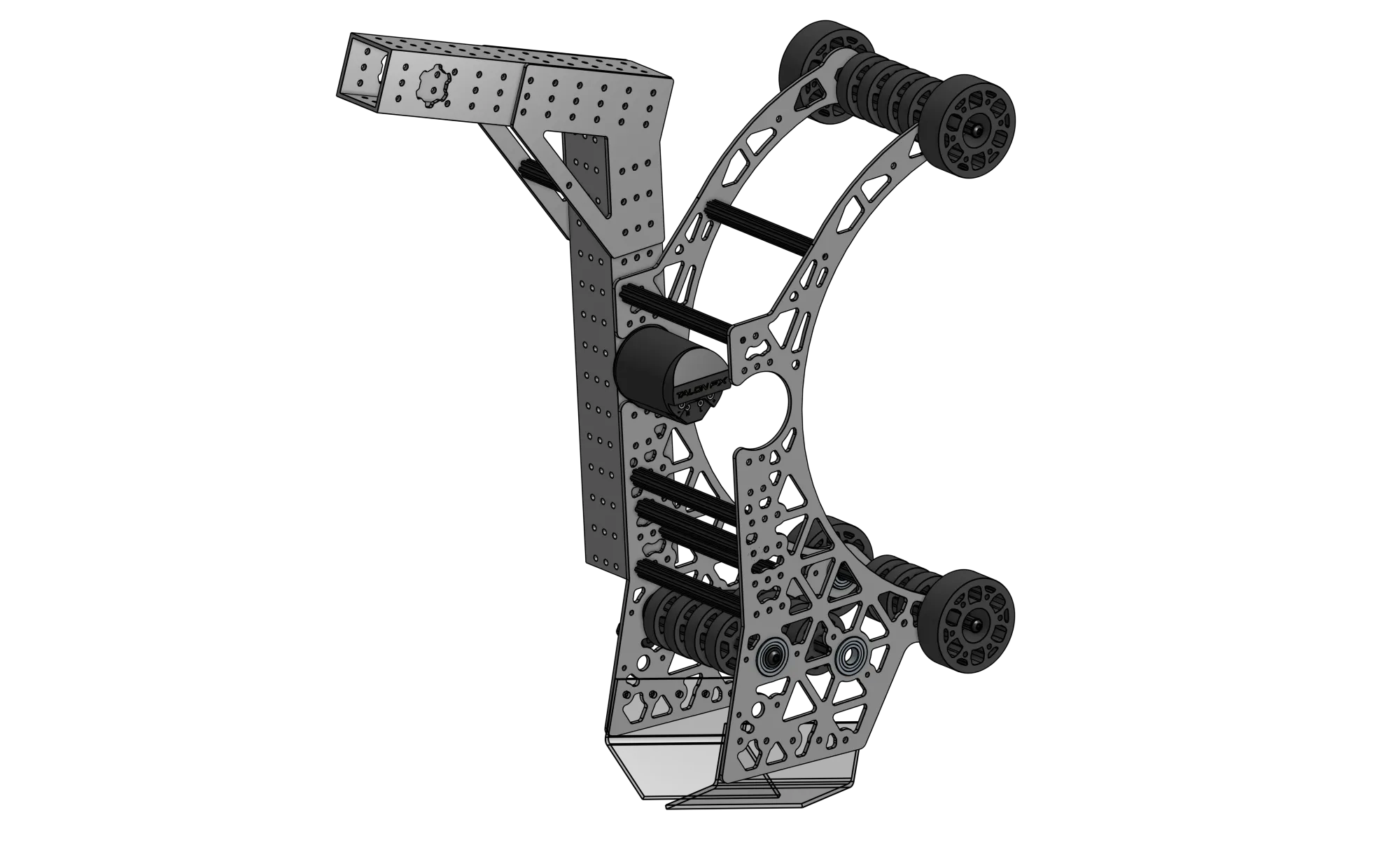
Oceanus's end effector featured an arm and a game piece manipulator. The arm runs on a MAXSpline deadaxle in which the arm can freely rotate about. The arm is driven by a Kraken X60 geared to 12:1 near the bottom of the carriage with a chain run to the big sprocket at the top of the carriage. The manipulator was powered by a Kraken X60 with three sets of rollers on the bottom and one at the top. The first two sets bottom sets and the one top set were 2" compliant wheels, and the last set was a mix of small solid wheels and two large solid wheels on the sides. The reason for this was we wanted better grip near the end for both the coral and algae. Two changes we made throughout the season were to add a hardstop on the bumper in front of the end effector to prevent coral from shooting out of the end effector when coming from the indexer. Also, we added a "diaper," which was a piece of fabric that would cover the bottom of the end effector as we found that sometimes coral would fall into there from freak accidents, and we couldn't get it out.
Takeaways
Weight was a huge issue for us this year. We had to make a lot of decisions with weight in mind. For example, we originally planned to have a dedicated ground algae intake, but we had to scratch that idea because it was too heavy even after we completely stripped it down to basically just polycarb, some rollers, and a Kraken X44. There was not one subsystem where we didn't have to make weight compromises. Systems like the climber and elevator went through a lot of strain, and we had to develop solutions to minimize the damage of every competition. As this was our most successful and demanding season to date, this was essential. Also time and resources were a huge factor. Because we built two robots, we needed to make sure we had enough to build both robots to be competitive. This did mean a lot of us stayed until far too late into the night to make sure we were on schedule. This was an incredible final hurrah for me and every other senior on the team. While there were many times in the season many of us were frustrated, angry, and tired, we never gave up because as street poet and philosopher DJ Khaled once said, "Never stop. Never Settle."
Programming Documentation
General Overview
Oceanus's programming used the same architecture as our previous few robots. (IO/subsystem structure) We used a command-based architecture with a subsystem for each major system on the robot. We used IntelliJ IDEA as our IDE, Java as our language, Elastic as our dashboard, AdvantageKit for logging, and a combination of Choreo and Pathplanner for autonomous. One thing that was different was we used two separate controllers because we had so many different operations. The driver controller controls the robot's movement, intake/outtake, arm rollers, auto-alignment, and other driving-related functions. The operator controller controls the scoring mechanisms, including the elevator and arm positions, scoring level selection, algae removal, automatic intake, and the climber. Check out the repository here → Oceanus Github
Supersystem State Machine
Building on lessons learned from our 2024 robot, we designed Oceanus with a Supersystem that coordinates the elevator and arm. This prevents the mechanisms from entering unsafe positions or colliding with the robot or field elements during operation. Rather than controlling each mechanism independently, the robot uses predefined states that move both mechanisms together through safe, repeatable motions. The available states are:
- HOME – Returns the elevator and arm to their default stowed position.
- INTAKE – Positions the mechanisms to collect coral from the hopper.
- L2, L3, L4 – Moves the elevator and arm to the correct scoring height for each reef level.
- ALGAE_L2 and ALGAE_L3 – Positions the robot to remove algae from the reef.
- BARGE – Moves the mechanisms into the preset barge-scoring configuration.
Using preset states simplifies operation for the drivers while significantly reducing the risk of collisions between mechanisms. Instead of manually controlling the elevator and arm independently, the operator simply selects a desired state, and the Supersystem safely coordinates both mechanisms. During automatic scoring, the Supersystem also works alongside the drivetrain to prevent collisions with the reef. The robot first aligns itself with the selected scoring location before extending the elevator and arm, and for higher scoring levels it waits until the mechanisms have reached their target positions before completing the final approach. This coordinated sequence improves scoring consistency while helping protect the robot from accidental contact with the reef.
Automatic Alignment
To simplify scoring, the robot includes an automatic alignment feature that drives to the closest scoring location. The driver can choose whether to align to the left or right branch of the nearest reef. Once selected, the software determines the nearest matching branch and generates the commands needed to position the robot for scoring. By combining drivetrain odometry with AprilTag-based vision, the robot maintains an accurate estimate of its position throughout the alignment process.
The operator first selects the desired scoring level (L2, L3, or L4). When the driver activates auto-alignment, the robot performs the following sequence:
- Finds the closest scoring location.
- Drives to the selected left or right reef branch.
- Moves the elevator and arm to the selected scoring position.
- Waits until mechanisms reach their setpoints before completing the final approach.
- Finishes aligned and ready to score.
This coordinated process improves scoring consistency, reduces driver workload, and helps prevent collisions with the reef by ensuring the robot and its mechanisms are properly positioned before scoring.
Simulation
Throughout development, our programming lead Logan utilized a lot of simulations. There were many times where he couldn't get his hands on the physical robot and had to do work from home, or he wanted to test out a command in simulation before implementing it on the field. it was during these moments where tools, such as AdvantageScope and MapleSim, came in clutch. The simulation environment models the drivetrain and robot mechanisms, allowing the verification of subsystem behavior, autonomous routines, and command logic.
Autonomous
Oceanus's autonomous routines were developed using a combination of Choreo and PathPlanner to create smooth, reliable paths while coordinating multiple robot subsystems. During intake sequences, the robot used sensor feedback to confirm that a game piece had been collected before continuing to the next action, making the routines more consistent than relying only on timed commands. After extensive tuning and testing, we achieved reliable 3.5-piece autonomous routines from both the left and right starting positions. We also developed additional autonomous routines that allowed the robot to remove algae from the reef and score it into the barge, giving the robot multiple ways to contribute during the autonomous period.
Gallery